
Rockstar almost never explains its own jokes. So when the studio's narrative lead sits down with a magazine and spells out why GTA VI dodges direct political references on purpose, that is worth slowing down for.
The interview is in Love Magazine, and the person talking is Rupert Humphries, Rockstar's senior vice president of narrative. Video Games Chronicle and Rock Paper Shotgun both picked it up on October 5, and the quotes are consistent across them. This is not a leak or a fan theory. It is the studio's narrative head, on the record, describing how the team decided what Leonida would and would not make fun of.
His answer is more specific than the usual "we're just satirizing everything" line. Asked how central politics is to the game, Humphries went back to the older entries first. "If you go back to the previous GTAs, there's never really been much focus on national politics," he said. He acknowledged the exception openly. The rise of Homeland Security and the Patriot Act were central to GTA IV, but he tied that to a specific time and place, post-9/11 New York, where those issues were the real local story.
That is the frame for GTA VI. Humphries said the team wants the game to feel specific to the moment it releases without recreating "the exact world we live in." His wording on the boundary is blunt: the studio does not want to be "too specific about any particular person, event, movement, or anything like that."
What that does not mean is that Leonida is apolitical. It means the politics are fictional and exaggerated rather than copied from a named real-world figure. Humphries said players will run into election signs, pick up robocalls from campaigns, and hear commercials and political talk shows on the radio. The satire is in the texture, and it is deliberately warped. "There is a big focus on not just holding up a mirror, but on making everything satirical, larger than life, and more grotesque," he said. Rockstar's own framing of the trade-off is almost a punchline: if it were a straight reflection, "you could just go outside and live in the real world."
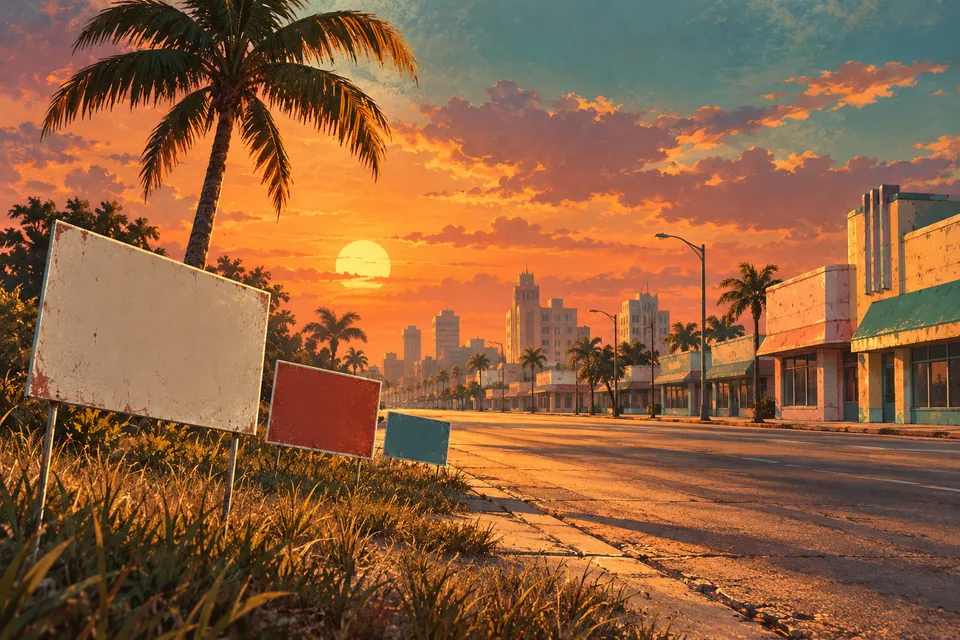
One detail in the reporting is genuinely new and easy to miss. Rock Paper Shotgun noted that one of the official Ambrosia screenshots already shows signage drumming up votes for a fictional candidate named Erin Henshaw. That is the studio's approach in a single image. The mechanism of a campaign is right there on the street. The candidate is invented. Nothing points at a real politician, and the game is not asking you to decode a stand-in.
Humphries also explained the method behind what the writers picked to parody at all. "We took things that interested us, like the conspiracy theories, the strange ways the public reacts to everyday occurrences, and those are the kinds of things we ran with," he said. Instead of a like-for-like copy of any real event, he said the team built "our own slanted, overblown versions" of a conspiracy theory or another "universal contemporary phenomenon." That is a decision to satirize the shape of an idea rather than the specific people carrying it this month.
There is a practical reason for that choice, and Humphries named it. GTA games take years to make, and a joke pinned to one news cycle ages fast. "We work on it for years and years, so you need to make content that will feel vital to the moment of release," he said. "If there's a trend blowing up for six months, you need to see it for what it is and not jump on the bandwagon."
This is where the interview lines up with something Rockstar's Rob Nelson said earlier. In a French interview timed to the An Extended Look premiere in August, Nelson made the same argument in different words: the studio only satirizes something if it might still land in ten or twenty years, and he compared the older games to time capsules. Two of the studio's most senior creative figures, two separate interviews, the same conclusion. Rockstar is not trying to out-meme the internet. It is trying to build a Florida that still reads as Florida a decade after launch.
It is worth being careful about what this interview is not. It is not an announcement. There is no new trailer, no gameplay system, no release change, no word on PC. The November 19, 2026 launch on PlayStation 5 and Xbox Series X|S still stands, and the $79.99 Standard and $99.99 Ultimate editions are unchanged. Humphries talked about creative intent, not product features. Treating his quotes as news about the game's mechanics would be reading something into them that is not there.
The honest boundary is this. It is confirmed that Rockstar's narrative lead said the studio avoids naming real-world political figures, that it uses invented, exaggerated versions of political texture, and that in-world election signs, robocalls and political radio are part of Leonida's dressing. It is not confirmed how any of that plays out in missions, story beats, or how far the satire pushes into specific real-world echoes. The philosophy is on the record. The execution is still under wraps.
That separation matters more than usual here, because politics is exactly the topic where GTA fans tend to fill in the blanks. Every screenshot with a scrap of signage gets pulled apart for a hidden message. Humphries is effectively telling readers not to bother looking for one. The signs, the calls, and the talk shows are the joke. The invented candidate is the tell that Rockstar would rather build its own world than hold a mirror to this one.
Read against the last few months of GTA VI coverage, the value of the interview is that it closes off a whole category of speculation without teasing anything new. It rules out the "they're going to go after a real politician" theory. It explains why the world is built from exaggerated types instead of named targets. And it sets a clear expectation for launch: expect a Leonida that is loud, ugly, funny about power, and entirely its own invention.
So the useful takeaway for readers is not that GTA VI is avoiding politics. It is that Rockstar is doing politics the way it does everything else, through a world that is recognizably Florida without being a copy of any given week of it. The election signs are real within the fiction. The politician on them is not. That is the line, and now it is on the record from the person who wrote it.